Tronxy Moore 2 Pro Reviews: See Why 0 Shoppers Rated It 0 Stars!
It’s not just hype. The Tronxy Moore 2 Pro 3d printer earned its 0/5 from 0 real users. But what’s behind those stars?
 Supermod
 Moderator
 Recaptor
Tronxy Moore 2 Pro Review: A Solid 3D Printer for Intermediate to Professional Users
The Tronxy Moore 2 Pro is a 3D printer tailored primarily for users who seek a blend of educational and prototyping capabilities. Officially released in 2022, this FDM/FFF printer stands out because it targets intermediate to professional users, offering an open-frame Cartesian design that is both versatile and reliable on paper. The overall engineering and design suggest that it is built to perform steadily with consistent print quality, making it a noteworthy contender in the mid-range 3D printing market.
Detailed Specs & Features
According to specs, the Moore 2 Pro sports a generous build volume of 1032.7 cubic inches, translating to a build width, depth, and height of approximately 10 inches each. This gives users a balanced spatial capacity for most prototyping tasks. It operates within an operating temperature range of 46.4 to 104°F and can handle an input voltage range from 110 to 220 volts, providing global adaptability without extra equipment.
Based on its engineering data, the printer includes a 3.5-inch touchscreen display that enhances usability with intuitive controls. It utilizes a single extruder with replaceable hotend capability, designed for reliable filament extrusion, although it lacks multi-material printing support. Prints adhere to a glass bed that is removable, which aids in post-print handling. Notably, the printer requires manual bed leveling, eschewing auto-leveling options.
From a connectivity standpoint, it supports USB and SD card file transfer methods with compatibility for popular formats like STL and G-code. Firmware updates are possible but must be done manually since no network or remote update functionality exists. Safety certifications such as CE, FCC, and RoHS underscore its compliance with established standards, and safety features like overheat protection and auto shutdown on error provide an added layer of security for consistent operation.
All in all, the specs paint a picture of a no-nonsense, well-rounded machine built to satisfy key user needs for everyday prototyping and learning, without the bells and whistles of advanced automation or multi-material complexity.
User Experience & Performance (Based On Specs)
Design & Build
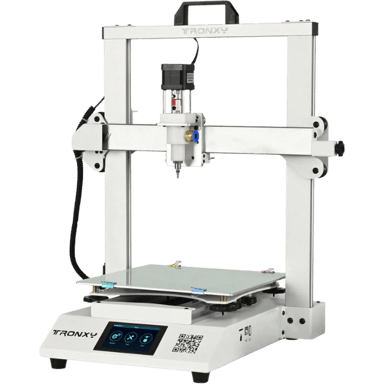
The open-frame, Cartesian frame type measures roughly 16 inches each in width and depth and about 20 inches tall, weighing a sturdy 33 pounds. This footprint ensures a stable print environment while requiring just over 1 square foot of workspace, making it compact enough for desktop use in home or educational settings. The printer arrives as a kit, with assembly required, which might appeal to enthusiasts who enjoy hands-on setup and maintenance.
On the flip side, the lack of an enclosure means prints might be more susceptible to ambient temperature fluctuations or dust. However, the device is engineered to operate reliably within a moderate temperature and humidity range. The sturdy glass build plate is removable and has a unique surface texture that assists adhesion, but users must manually level the bed, which requires some initial calibration knowledge.
Performance
The Moore 2 Pro reaches an official max print speed of 30 mm/s, but its effective speed can reach up to 40 mm/s while maintaining a print accuracy of 100 microns. This is quite respectable in this category, ensuring detailed and precise prototyping. The printer supports continuous printing operations for up to 24 hours, which aligns nicely with professional or educational needs where longer prints may be necessary.
What stands out most for sustained work is the presence of a print recovery feature that allows the machine to resume after power loss, minimizing time and material waste. However, noise levels during printing hover around 50 dB, which is relatively moderate but may require consideration in noise-sensitive environments.
Hardware Features
The printer relies on belt and rod motion systems to deliver stable and consistent layer deposition, complemented by the spare parts availability that supports hotend replacement and nozzle maintenance. While the device lacks cooling fans or vibration compensation technologies, the manual bed leveling and glass build plate design preserve print quality across different filament runs. Its power supply is internal, helping reduce clutter and complexity.
Extra Features
Though this model doesn't offer advanced automation features like filament runout sensors, spaghetti-fault detection, or any cloud software integration, it covers essential bases efficiently. The absence of multi-material printing and filament auto-loading reflects its focus on simplicity and reliability over experimental flexibility. Additionally, the lack of a filament dry box suggests that users should store filaments properly to prevent moisture issues.
Pros & Cons
Pros
- Generous build volume supporting versatile prototyping needs
- Reliable print recovery feature safeguards against power interruptions
- Included safety certifications and overheat protection for peace of mind
- Intuitive touchscreen controls with firmware update capability
Cons
- Lacks multi-material printing and filament auto-loading features
- Manual bed leveling can be challenging for less experienced users
- No enclosure or filament runout sensor, affecting print environment control
- Assembly required, which might deter beginners looking for plug-and-play ease
Price & Value For Money
Priced at $648.75 at AliExpress, the Moore 2 Pro presents a compelling value proposition within the intermediate 3D printer market. Given its one-year warranty and broad power supply voltage range, the pricing feels justified for users wanting robust prototyping capabilities without the complexity or cost of premium-tier printers.
That being said, buyers who prioritize advanced automation, multi-material processes, or a fully enclosed build environment may find better value elsewhere, especially in pricier but more feature-packed alternatives. However, for educational institutions or professionals requiring solid print quality and reliability, this device strikes a practical middle ground.
Quick Take
In short, the Tronxy Moore 2 Pro is an effective solution for those seeking a dependable and moderately versatile 3D printer, especially suited for intermediate to advanced users. If we look at the numbers alone, it successfully balances print volume, accuracy, and recovery features in a compact footprint. Its price and specs together make it an appealing option for educational and prototyping needs, though it steers away from multi-material experimentation or plug-and-play conveniences.
Closing Recommendation
The Moore 2 Pro may be ideal for users who appreciate hands-on assembly and manual calibration, coupled with the need for a reliable print volume and consistent accuracy. It appears to perform best for educational settings and professional prototyping where print reliability and safety are paramount. While it lacks some of the latest automation and sensor technologies, it helps users achieve quality prints without overcomplication, supported by solid certifications and a practical price point.
Verdict
Rating: Based on the specifications and overall feature set, we believe the Tronxy Moore 2 Pro deserves 4.2 out of 5.
- Winner Feature => Robust build volume and effective print recovery that enhances reliability.
- Needs Improvement => Lack of multi-material printing and auto-leveling limits convenience and versatility.
Reviews 0
The good, the bad, and the brutally honest.Average Rating


More 3D Printers 453
Unlock more awesome finds.